
Mumbai Court Refuses BMW Release In Worli Hit-And-Run Case
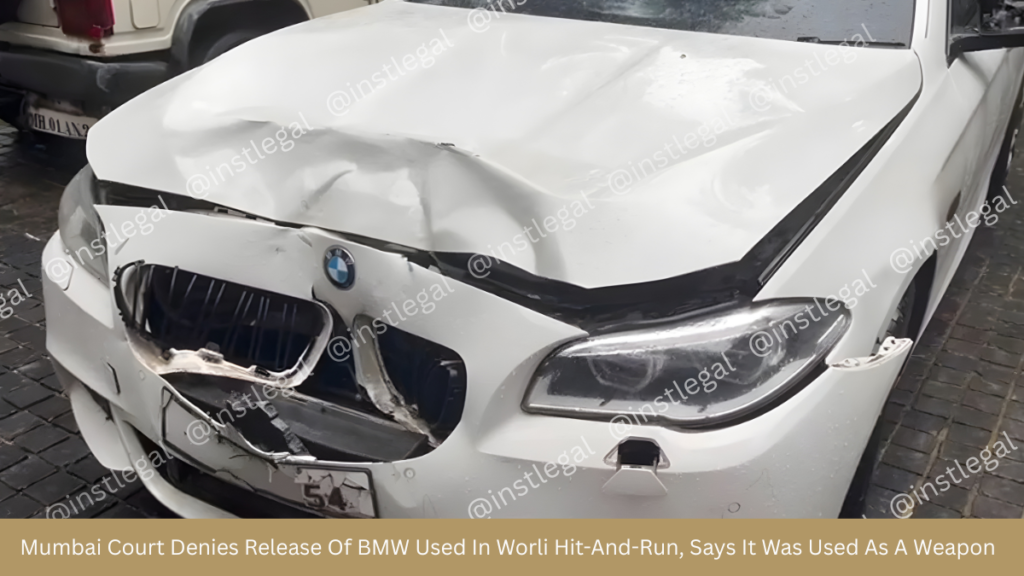
A Mumbai sessions court has refused to release the BMW car involved in the high-profile Worli hit-and-run case. In a significant order, the Mumbai court refuses BMW release and said the vehicle was allegedly used “like a weapon” and remains crucial evidence in the ongoing criminal proceedings.
The court rejected the plea filed by accused Mihir Rajesh Shah. He had sought custody of the seized luxury vehicle linked to the fatal Worli accident in July 2024.
Mumbai Court Calls BMW A Weapon In Worli Hit-And-Run Case
Additional Sessions Judge Anil D. Salunkhe ruled that the accused allegedly drove the car dangerously. Moreover, the fatal consequences made the vehicle a critical piece of evidence.
The court observed that the accused allegedly drove the car dangerously. Therefore, the fatal outcome justified treating the vehicle as critical evidence.
According to the order, the court could not rule out the risk of the accused altering, tampering with, or misusing the vehicle.
Background Of The Worli Hit-And-Run Case
The case stems from a tragic incident that occurred on July 7, 2024, in Mumbai’s Worli area.
As per the prosecution, complainant Pradeep Nakhva and his wife Kaveri Nakhva were travelling on a scooter when the BMW allegedly hit them.
Meanwhile, the accident resulted in the death of Kaveri, while Pradeep sustained injuries.
Following the incident, the police registered an FIR under the Bharatiya Nyaya Sanhita (BNS) and the Motor Vehicles Act.
Accused Sought BMW Release For Personal Use
During the hearing, Mihir Shah argued that he had lawfully purchased the BMW and required it for his personal and family use.
The defence sought the release of the vehicle from police custody, contending that continued seizure was causing hardship.
However, the prosecution strongly opposed the application.
The State argued that the incident was a grave criminal matter involving a fatality and that the vehicle itself constituted material evidence.
The State said returning the car now could compromise the evidence and affect the investigation and trial.
Court Emphasises Preservation Of Evidence
The Mumbai court accepted the prosecution’s objections and underlined the need to preserve the BMW in its current condition.
The court noted that releasing the vehicle could risk modification or destruction of key evidence linked to the alleged offence.
Given the seriousness of the allegations and the death caused in the incident, the court concluded that no relief could be granted to the accused at this stage.
This ruling may significantly affect one of Mumbai’s most closely watched road accident cases.
Read More: Supreme Court latest legal news
FAQs
Under Section 106 BNS, hit-and-run cases can lead to up to 5 years’ jail + fine. Section 106(2) provides up to 10 years’ jail + fine if the driver flees, but this clause is currently deferred. Victim families get ₹2 lakh compensation in death cases and ₹50,000 for injury
In fatal hit-and-run cases, police commonly invoke BNS Section 106(1) for causing death by negligence and Section 281 for rash driving, along with relevant Motor Vehicles Act provisions. In more serious cases, courts may also apply Section 105 BNS (culpable homicide), as seen in the Worli BMW hit-and-run case.
A court may release a seized vehicle on interim custody in some cases, but it depends on the gravity of the offence, the stage of investigation, and the evidentiary value of the vehicle. In serious cases involving death or culpable homicide allegations, courts may refuse release if the vehicle is considered material evidence.