
Strict Timeline Set for Removal of Illegal Setbacks in Uttar Pradesh
In a major crackdown on illegal constructions in Uttar Pradesh’s Meerut, the Supreme Court of India on Thursday April 9 directed authorities to demolish all unauthorized setbacks across 859 properties within two months. The Court strongly criticized officials for allowing schools, hospitals, and even nationalized banks to operate from buildings that were “absolutely illegal and unauthorized.”
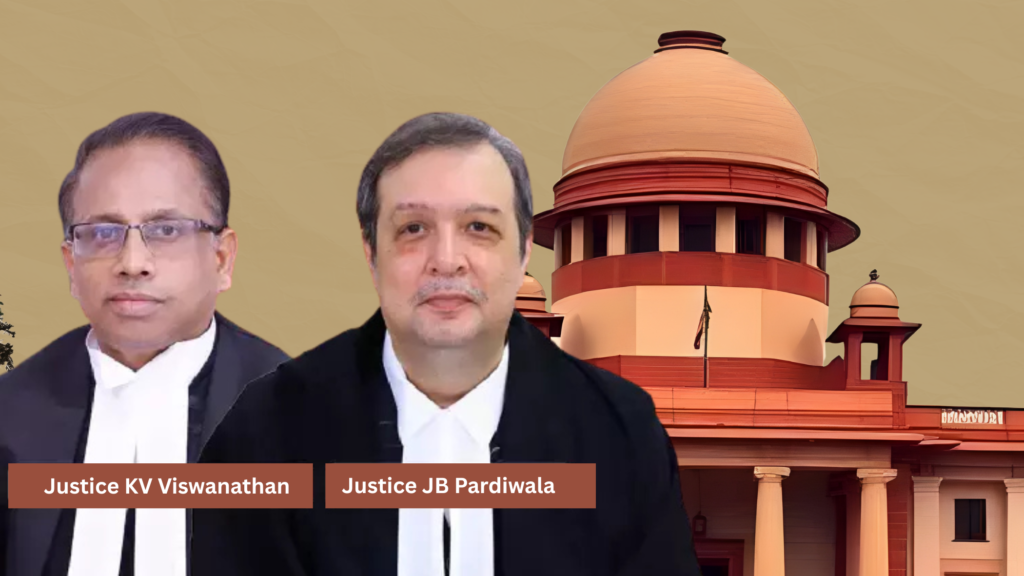
A bench of Justice JB Pardiwala and Justice KV Viswanathan made it clear that the “rule of law cannot succumb to public hue and cry,” ordering strict removal of encroachments on mandatory open spaces in Meerut’s Shastri Nagar area.
The Court noted that out of 859 unauthorized structures, 44 were being used commercially, including schools, hospitals, banquet halls, banks, and an NBFC. Expressing concern for public safety, the bench stated,
“What is important for us is lives of innocent children, people, patients. We are not concerned with your business. You are doing business at the cost of someone’s life.”
Questioning the legality of such establishments, Justice Pardiwala asked, “Who sanctioned this plan? Who gave the permission to put up this school? Where is the permission of the district education officer? Where is the license to run the school?”
Senior Advocate Rajiv Shakdher informed the Court that the next step would be demolition of all illegal setbacks, which the Court accepted. It granted two months’ time and made it clear that such encroachments cannot be regularized.
“There will be no question of compounding setbacks.We grant two months’ time to demolish all setbacks.” The bench reiterated,“They have said very clearly my instructions are set back cannot be compounded.”
The Court directed authorities to issue notices, allow 10 to 15 days for voluntary removal, and proceed with demolition in case of non compliance, with costs to be recovered from occupants. It also asked authorities to prepare a plan for the remaining 815 unauthorized properties and file an affidavit with before and after photographs of the 44 identified properties.
“The affidavit should also include photographs of each and every property. The photographs must be in two parts. The upper part of the photograph must be of before sealing and the latter part after sealing,”
Calling the case an “eye-opener,” the Court warned authorities across the country to act in time against illegal constructions.
The matter will next be heard in July 2026.
This aligns with the Supreme Court’s approach to sentencing and penalties in recent cases