
How Supreme Court Orders School Shutdown for Loan Default Under SARFAESI
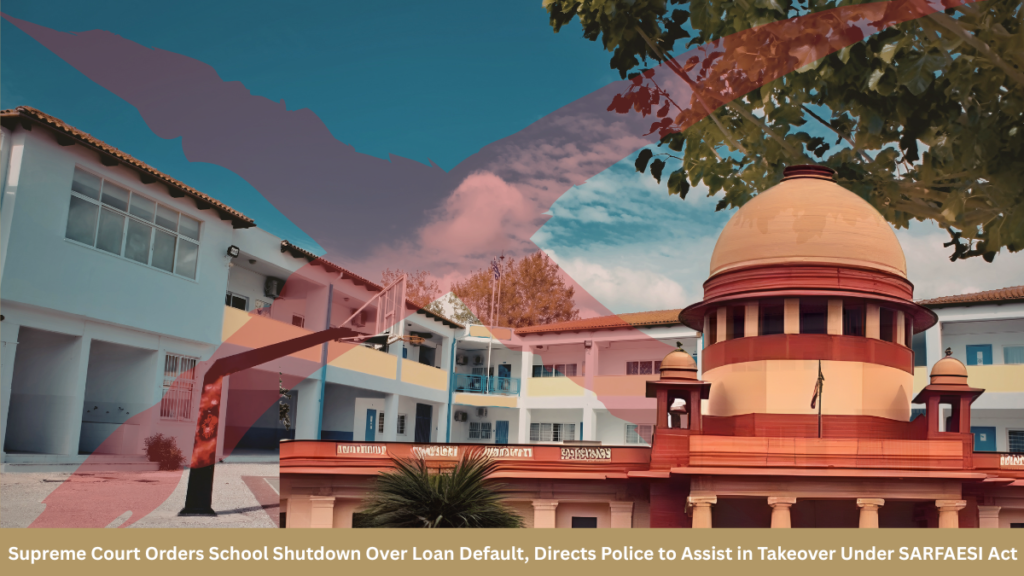
The Supreme Court orders school shutdown for loan default in a significant ruling under the SARFAESI Act. The Court directed a private school in Kolhapur, Maharashtra, to shut from May 1, 2026, after the management repeatedly defaulted on loan repayments of over ₹5 crore and obstructed recovery proceedings.
A bench of Justice Dipankar Datta and Justice Satish Chandra Sharma observed that the school management repeatedly sought time before the courts, promised repayment, and then failed to honour its commitments. The bench said this conduct showed an “extreme lack of solicitude for the rule of law.”
Supreme Court Allows Police Aid for Takeover
The Supreme Court orders school shutdown for loan default judgment also gives the secured creditor liberty to seek police assistance for taking peaceful possession of the school premises under the SARFAESI Act.
Keeping the Court’s statement unchanged:
“Since the secured creditor has failed in its attempt to secure a purchaser owing to alleged resistance offered / disturbances created by the petitioners, we grant liberty to the secured creditor to approach the Superintendent of Police, Kolhapur and the Station House Officer of the jurisdictional Police Station for rendering adequate help, assistance, support and cooperation to obtain peaceful and vacant possession of the secured asset.”
The Court made it clear that it will not tolerate physical resistance or forceful obstruction of lawful recovery proceedings. It also warned the appellants not to create any hindrance during the takeover process.
Court Criticises Repeated Defaults
The dispute began after the lender issued a demand notice under the SARFAESI Act seeking recovery of outstanding dues. When the borrower failed to repay the amount, the creditor initiated recovery proceedings and moved to take possession of the property of Chaitanya Public School and Junior College.
Since the final examinations had concluded and parents had already been informed, the Court ordered the school’s closure from the forenoon of May 1. The bench dismissed the appeal and allowed the creditor to proceed with possession.
Read our detailed analysis on AI in legal practice 2026 and how technology is reshaping law firms.
FAQs
Loan default under the SARFAESI Act arises when a borrower fails to repay the loan, and the account is declared an NPA (Non-Performing Asset). Once this happens, the lender may issue a recovery notice and take possession of the secured asset to recover the pending dues.